




Sojourner Truth, Abolitionist and Human Rights Activist

Sojourner Truth (born Isabella Bomefree; c. 1797 – November 26, 1883) was an American abolitionist and activist for African-American civil rights, women’s rights, and alcohol temperance. Truth was born into slavery in Swartekill, New York, but escaped with her infant daughter to freedom in 1826. After going to court to recover her son in 1828, she became the first black woman to win such a case against a white man.

This Black History Month story is brought to you by

Testifying to the Hope that Was in Her

She gave herself the name Sojourner Truth in 1843 after she became convinced that God had called her to leave the city and go into the countryside “testifying to the hope that was in her.” Her best-known speech was delivered extemporaneously, in 1851, at the Ohio Women’s Convention in Akron, Ohio. The speech became widely known during the Civil War by the title “Ain’t I a Woman?”, a variation of the original speech that was published in 1863 as being spoken in a stereotypical Black dialect, then more commonly spoken in the South. Sojourner Truth, however, grew up speaking Dutch as her first language.

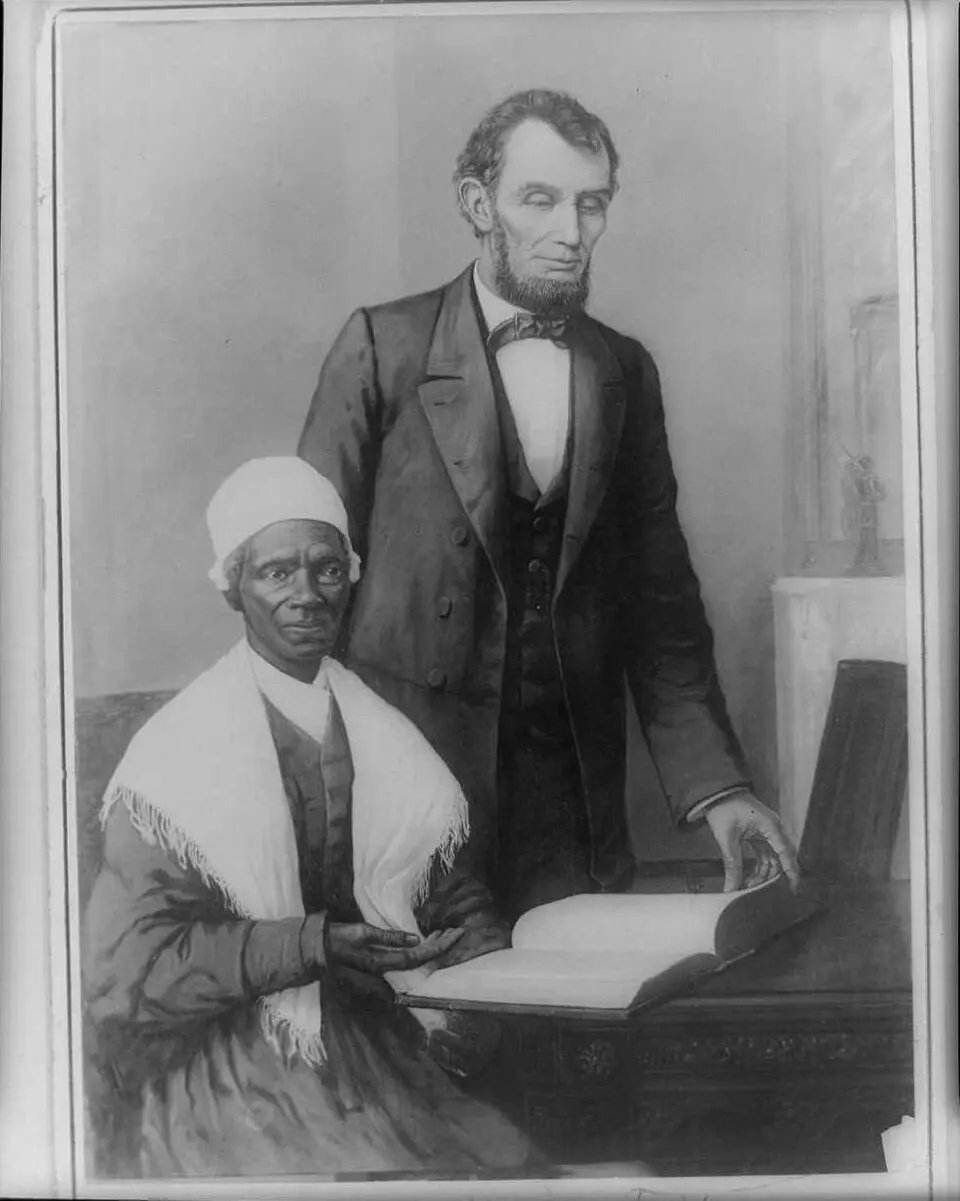
Painting of Sojourner Truth with Abraham Lincoln
Library of Congress Catalog:
Link to Image

During the Civil War, Truth helped recruit Black men into the Union army; after the war, she tried unsuccessfully to secure land grants from the federal government for formerly enslaved people (summarized as the promise of “forty acres and a mule”). She continued to fight on behalf of women and African Americans until her death. As her biographer Nell Irvin Painter wrote, “At a time when most Americans thought of slaves as male and women as white, Truth embodied a fact that still bears repeating: Among the blacks are women; among the women, there are blacks.”

A memorial bust of Truth was unveiled in 2009 in Emancipation Hall in the U.S. Capitol Visitor Center. She is the first African American woman to have a statue in the Capitol building. In 2014, Truth was included in Smithsonian magazine’s list of the “100 Most Significant Americans of All Time”.
The Result of Freedom

The year 1843 was a turning point for her. On June 1, Pentecost Sunday, she changed her name to Sojourner Truth. She chose the name because she heard the Spirit of God calling on her to preach the truth. She told her friends: “The Spirit calls me, and I must go”, and left to make her way traveling and preaching about the abolition of slavery. Taking along only a few possessions in a pillowcase, she traveled north, working her way up through the Connecticut River Valley, towards Massachusetts.

At that time, Truth began attending Millerite Adventist camp meetings. Millerites followed the teachings of William Miller of New York, who preached that Jesus would appear in 1843–1844, bringing about the end of the world. Many in the Millerite community greatly appreciated Truth’s preaching and singing, and she drew large crowds when she spoke. Like many others disappointed when the anticipated second coming did not arrive, Truth distanced herself from her Millerite friends for a time.

In 1844, she joined the Northampton Association of Education and Industry in Florence, Massachusetts. Founded by abolitionists, the organization supported women’s rights and religious tolerance as well as pacifism. There were, in its four-and-a-half-year history, a total of 240 members, though no more than 120 at any one time. They lived on 470 acres (1.9 km2), raising livestock, running a sawmill, a gristmill, and a silk factory. Truth lived and worked in the community and oversaw the laundry, supervising both men and women. While there, Truth met William Lloyd Garrison, Frederick Douglass, and David Ruggles. Encouraged by the community, Truth delivered her first anti-slavery speech that year.

In 1845, she joined the household of George Benson, the brother-in-law of William Lloyd Garrison. In 1846, the Northampton Association of Education and Industry disbanded, unable to support itself. In 1849, she visited John Dumont before he moved west.

Truth started dictating her memoirs to her friend Olive Gilbert and in 1850 William Lloyd Garrison privately published her book, The Narrative of Sojourner Truth: a Northern Slave. That same year, she purchased a home in Florence for $300 and spoke at the first National Women’s Rights Convention in Worcester, Massachusetts. In 1854, with proceeds from sales of the narrative and cartes-de-visite captioned, “I sell the shadow to support the substance”, she paid off the mortgage held by her friend from the community, Samuel L. Hill.

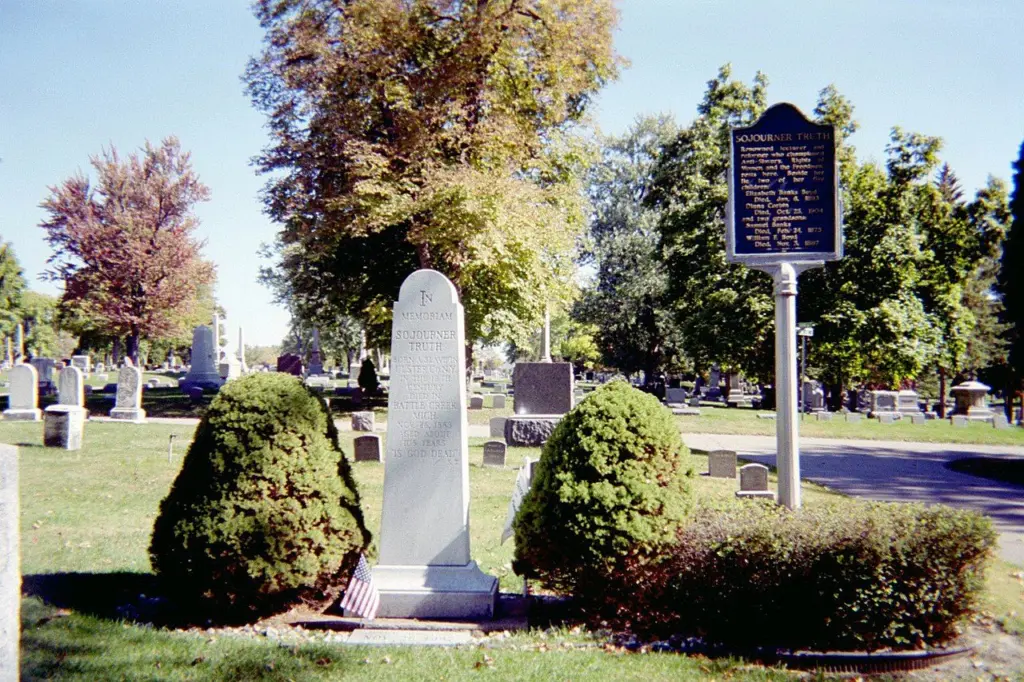
By Battle Creek CVB - Sojourner Truth Headstone- Oakhill Cemetery, CC BY 2.0, https://commons.wikimedia.org/w/index.php?curid=129879045

Ain't I a Woman?

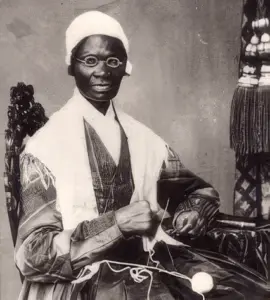
Sojourner Truth
Sojourner Truth

In 1851, Truth joined George Thompson, an abolitionist and speaker, on a lecture tour through central and western New York State. In May, she attended the Ohio Women’s Rights Convention in Akron, Ohio, where she delivered her famous extemporaneous speech on women’s rights, later known as “Ain’t I a Woman?”. Her speech demanded equal human rights for all women. She also spoke as a former enslaved woman, combining calls for abolitionism with women’s rights, and drawing from her strength as a laborer to make her equal rights claims.
In the version recorded by Rev. Marius Robinson, Truth said:

I want to say a few words about this matter. I am a woman’s rights. [sic] I have as much muscle as any man, and can do as much work as any man. I have plowed and reaped and husked and chopped and mowed, and can any man do more than that? I have heard much about the sexes being equal. I can carry as much as any man, and can eat as much too, if I can get it. I am as strong as any man that is now. As for intellect, all I can say is, if a woman have a pint, and a man a quart – why can’t she have her little pint full? You need not be afraid to give us our rights for fear we will take too much, – for we can’t take more than our pint’ll hold. The poor men seems to be all in confusion, and don’t know what to do. Why children, if you have woman’s rights, give it to her and you will feel better. You will have your own rights, and they won’t be so much trouble. I can’t read, but I can hear. I have heard the Bible and have learned that Eve caused man to sin. Well, if woman upset the world, do give her a chance to set it right side up again. The Lady has spoken about Jesus, how he never spurned woman from him, and she was right. When Lazarus died, Mary and Martha came to him with faith and love and besought him to raise their brother. And Jesus wept and Lazarus came forth. And how came Jesus into the world? Through God who created him and the woman who bore him. Man, where was your part? But the women are coming up blessed be God and a few of the men are coming up with them. But man is in a tight place, the poor slave is on him, woman is coming on him, he is surely between a hawk and a buzzard.

Finding Freedom

In 1799, the State of New York began to legislate the abolition of slavery, although the process of emancipating slaves in New York was not complete until July 4, 1827. Dumont had promised to grant Truth her freedom a year before the state emancipation, “if she would do well and be faithful”. However, he changed his mind, claiming a hand injury had made her less productive. She was infuriated but continued working, spinning 100 pounds (45 kg) of wool, to satisfy her sense of obligation to him.

Late in 1826, Truth escaped to freedom with her infant daughter, Sophia. She had to leave her other children behind because they were not legally freed in the emancipation order until they had served as bound servants into their twenties. She later said, “I did not run off, for I thought that wicked, but I walked off, believing that to be all right.”

She found her way to the home of Isaac and Maria Van Wagenen in New Paltz, who took her and her baby in. Isaac offered to buy her services for the remainder of the year (until the state’s emancipation took effect), which Dumont accepted for $20. She lived there until the New York State Emancipation Act was approved a year later.

Truth learned that her son Peter, then five years old, had been sold by Dumont and then illegally resold to an owner in Alabama. With the help of the Van Wagenens, she took the issue to the New York Supreme Court. Using the name Isabella van Wagenen, she filed a suit against Peter’s new owner Solomon Gedney. In 1828, after months of legal proceedings, she got back her son, who had been abused by his owners. Truth became one of the first black women to go to court against a white man and win the case.[27][28][29] The court documents related to this lawsuit were rediscovered by the staff at the New York State Archives c. 2022.

In 1827, she became a Christian and participated in the founding of the Methodist church of Kingston, New York. In 1829, she moved to New York City and joined the John Street Methodist Church (Zion African Methodist Episcopal Church).

Her early life

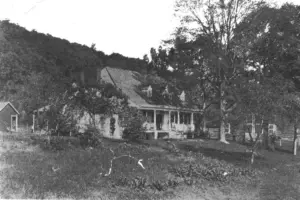
House of Johannes Hardenburgh, Paltz New York
By Book Author: Ralph LeFevre. Photographer: unknown.uploaded by User:Epousesquecido (also w:User:Epousesquecido) – Image was sourced from the collection of the State University of New York at New Paltz Sojourner Truth Libraryitem provenance: book: History of New Patlz New York and Its Old Families by Ralph LeFevre ISBN 9780806305516, Public Domain.

Sojourner Truth once estimated that she was born between 1797 and 1800. Truth was one of the 10 or 12 children born to James and Elizabeth Bomefree (later also given as Baumfree). Her father was a slave captured from what became Ghana, while her mother – nicknamed “Mau-Mau Bet” – was the daughter of slaves captured from the area of Guinea. Her father was nicknamed “Bomefree” (which, according to Truth, was Dutch for “tree”; compare boom boom, “tree”) due to his tall stature. Colonel Hardenbergh bought James and Elizabeth Bomefree from slave traders and kept their family at his estate in a big hilly area called by the Dutch name Swartekill (just north of modern Rifton), in the town of Esopus, New York, 95 miles (153 km) north of New York City. When she was an infant, her five year old brother and three year old sister were sold to a different estate. Her family would recount memories of the children sold into slavery, and her mother taught the children to pray. Her first language was Dutch, and she continued to speak with a Dutch accent for the rest of her life. Charles Hardenbergh inherited his father’s estate and continued to own slaves as a part of that estate’s property.

Sojourner Truth's Michigan Connection

Truth dedicated her life to fighting for a more equal society for African Americans and for women, including abolition, voting rights, and property rights. She was at the vanguard of efforts to address intersecting social justice issues. As historian Martha Jones wrote, “[w]hen Black women like Truth spoke of rights, they mixed their ideas with challenges to slavery and to racism. Truth told her own stories, ones that suggested that a women’s movement might take another direction, one that championed the broad interests of all humanity.”

Truth – along with Stephen Symonds Foster and Abby Kelley Foster, Jonathan Walker, Marius Robinson, and Sallie Holley – reorganized the Michigan Anti-Slavery Society in 1853 in Adrian, Michigan. The state society was founded in 1836 in Ann Arbor, Michigan.

In 1856, Truth bought a neighboring lot in Northampton, but she did not keep the new property for long. On September 3, 1857, she sold all her possessions, new and old, to Daniel Ives and moved to Battle Creek, Michigan, where she rejoined former members of the Millerite movement who had formed the Seventh-day Adventist Church. Antislavery movements had begun early in Michigan and Ohio. Here, she also joined the nucleus of the Michigan abolitionists, the Progressive Friends, some who she had already met at national conventions. From 1857 to 1867 Truth lived in the village of Harmonia, Michigan, a Spiritualist utopia. She then moved into nearby Battle Creek, Michigan, living at her home on 38 College St. until her death in 1883. According to the 1860 census, her household in Harmonia included her daughter, Elizabeth Banks (age 35), and her grandsons James Caldwell (misspelled as “Colvin”; age 16) and Sammy Banks (age 8).

Truth helped recruit black men into the Union army during the Civil War. Her grandson, James Caldwell, enlisted in the 54th Massachusetts Regiment. In 1864, Truth was employed by the National Freedman’s Relief Association in Washington, D.C., where she worked diligently to improve conditions for African-Americans. In October of that year, she was invited to the White House by President Abraham Lincoln. In 1865, while working at the Freedman’s Hospital in Washington, Truth rode in the streetcars to help force their desegregation.

Truth is credited with writing a song, “The Valiant Soldiers”, for the 1st Michigan Colored Regiment; it was said to be composed during the war and sung by her in Detroit and Washington, D.C. It is sung to the tune of “John Brown’s Body” or “The Battle Hymn of the Republic”. Although Truth claimed to have written the words, it has been disputed (see “Marching Song of the First Arkansas”).

In 1867, Truth moved from Harmonia to Battle Creek. In 1868, she traveled to western New York and visited with Amy Post, and continued traveling all over the East Coast. At a speaking engagement in Florence, Massachusetts, after she had just returned from a very tiring trip, when Truth was called upon to speak she stood up and said, “Children, I have come here like the rest of you, to hear what I have to say.”

In 1870, Truth tried to secure land grants from the federal government to former enslaved people, a project she pursued for seven years without success. While in Washington, D.C., she had a meeting with President Ulysses S. Grant in the White House. In 1872, she returned to Battle Creek, became active in Grant’s presidential re-election campaign, and even tried to vote on Election Day, but was turned away at the polling place.

Truth spoke about abolition, women’s rights, prison reform, and preached to the Michigan Legislature against capital punishment. Not everyone welcomed her preaching and lectures, but she had many friends and staunch support among many influential people at the time, including Amy Post, Parker Pillsbury, Frances Gage, Wendell Phillips, William Lloyd Garrison, Laura Smith Haviland, Lucretia Mott, Ellen G. White, and Susan B. Anthony.

Illness and death

Truth was cared for by two of her daughters in the last years of her life. Several days before Sojourner Truth died, a reporter came from the Grand Rapids Eagle to interview her. “Her face was drawn and emaciated and she was apparently suffering great pain. Her eyes were very bright and mind alert although it was difficult for her to talk.”

Truth died early in the morning on November 26, 1883, at her Battle Creek home. On November 28, 1883, her funeral was held at the Congregational-Presbyterian Church officiated by its pastor, the Reverend Reed Stuart. Some of the prominent citizens of Battle Creek acted as pall-bearers; nearly one thousand people attended the service. Truth was buried in the city’s Oak Hill Cemetery (photo of gravesite above).

Frederick Douglass offered a eulogy for her in Washington, D.C. “Venerable for age, distinguished for insight into human nature, remarkable for independence and courageous self-assertion, devoted to the welfare of her race, she has been for the last forty years an object of respect and admiration to social reformers everywhere.”

a-wchb-black-history-month-story

Information taken from Wikipedia contributors. (2026, January 3). Sojourner Truth. In Wikipedia, The Free Encyclopedia. Retrieved 15:58, January 28, 2026, from https://en.wikipedia.org/w/index.php?title=Sojourner_Truth&oldid=1330887883

Loading...