





Associated Press, Public domain, via Wikimedia Commons
.jpg)
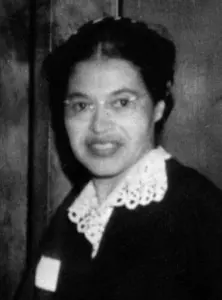
Born in Tuskegee, Alabama, Parks grew up under Jim Crow segregation. She later moved to Montgomery and joined the city’s chapter of the National Association for the Advancement of Colored People (NAACP) in 1943, serving as the organization’s secretary. Despite policies designed to disenfranchise Black citizens, Parks successfully registered to vote after three separate attempts between 1943 and 1945. She investigated cases and organized campaigns around cases of racial and sexual violence in her capacity as NAACP secretary, including those of Recy Taylor and Jeremiah Reeves, laying the groundwork for future civil rights campaigns.
Custom in Montgomery required Black passengers to surrender their seats in the front of the bus to accommodate white riders. The rows in the back were designated for Black riders. Before Parks’s refusal to move, several Black Montgomerians had refused to do so, including 15-year-old high school student Claudette Colvin, leading to arrests. When Parks was arrested in 1955, local leaders were searching for a person who would be a good legal test case against segregation. She was deemed a suitable candidate, and the Women’s Political Council (WPC) organized a one-day bus boycott on the day of her trial. The boycott was widespread. Many Black Montgomerians refused to ride the buses that day. After Parks was found guilty of violating state law, the boycott was extended indefinitely, with the Montgomery Improvement Association (MIA) organizing its own community transportation network to sustain it. Parks and other boycott leaders faced harassment, ostracization, and various legal obstacles. The boycott lasted for 381 days, finally concluding after segregation on buses was deemed unconstitutional in the court case Browder v. Gayle.
After the boycott ended, Parks experienced financial hardship and health problems due, in part, to her participation. In 1957, she relocated to Detroit, Michigan. She continued to advocate for civil rights, supporting people such as John Conyers, Joanne Little, Gary Tyler, Angela Davis, Joe Madison, and Nelson Mandela. She was also a supporter of the Black power movement and an anti-apartheid activist, participating in protests and conferences as part of the Free South Africa Movement. In 1987, she co-founded the Rosa and Raymond Parks Institute for Self Development with Elaine Eason Steele. After Parks’s death in 2005, she was honored with public viewings and memorial services in three cities: in Montgomery; in Washington, D.C., where she lay in state at the United States Capitol rotunda; and in Detroit, where she was ultimately interred at Woodlawn Cemetery. Parks received many awards and honors, both throughout her life and posthumously. She received the Presidential Medal of Freedom and a Congressional Gold Medal and was the first Black American to be memorialized in the National Statuary Hall.
Montgomery passed a city ordinance segregating streetcar passengers by race in 1900, before state-wide segregation was implemented. Montgomery’s Black residents conducted boycotts against segregated streetcars between 1900 and 1902, coinciding with similar boycotts and protests in other southern cities. The boycotts resulted in an amendment to the city ordinance, which stipulated that “no rider had to surrender a seat unless another was available”. However, many drivers failed to follow the ordinance. Altercations between bus drivers and Black passengers were frequent. According to historian Cheryl Phibbs, “bus drivers were given policeman-like authority to determine where racial divisions were enforced”. They were also generally armed.
By Rmhermen – own work by the original uploader , CC BY-SA 3.0, Link


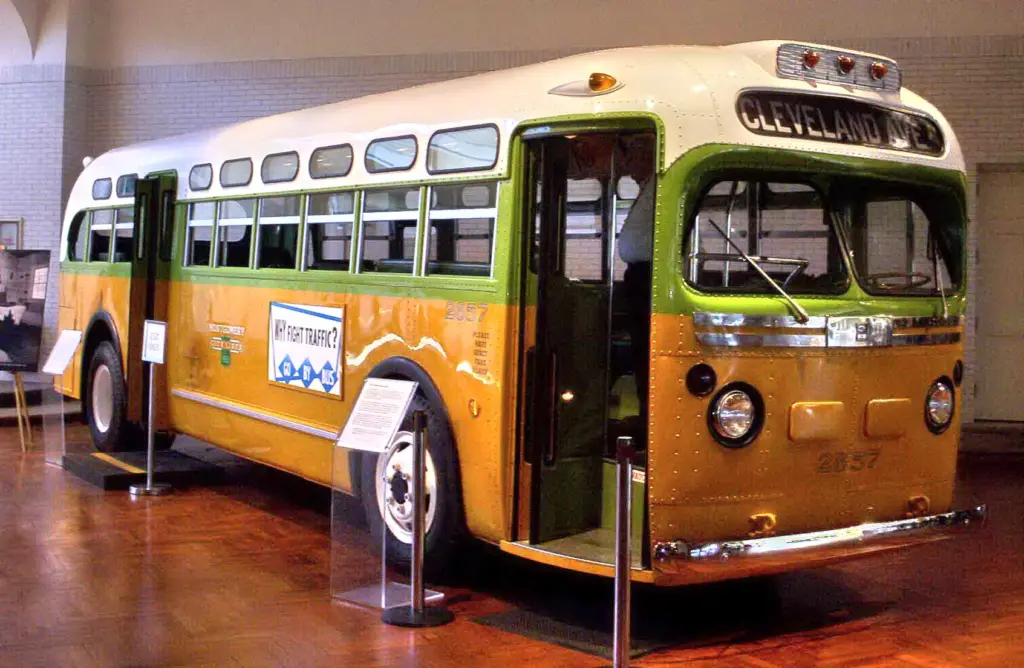
Black people constituted a majority of bus riders in Montgomery. According to the Women’s Political Council, a Montgomery-based advocacy group, “three-fourths of the riders” on Montgomery buses were Black. Despite this, the front rows on each Montgomery bus were reserved for white passengers, while the back rows were designated for Black passengers. Segregation in the middle rows was enforced at the driver’s discretion. While city ordinances did not require patrons to give up their seats, bus drivers frequently demanded Black passengers do so to accommodate white riders. Furthermore, Black passengers were sometimes required to pay their fares at the front of the bus, then exit and re-board through the back door.
In 1943, bus driver James F. Blake confronted Parks when she tried to take her seat from the front of the bus, insisting that she re-board in the back. Parks refused, telling Blake that she was “already on the bus and didn’t see the need of getting off and getting back on when people were standing in the stepwell”. After Blake grabbed her sleeve, Parks moved to the front of the bus, sitting in one of the rows reserved for white passengers, where she dropped her purse. Blake told her to “get off [his] bus”, appearing poised to assault her. Parks admonished Blake, saying that he “better not hit [her]”. She then exited the bus without re-boarding. After this encounter, she typically avoided riding on Blake’s bus.
By Police Department, City of Montgomery, Public Domain, Link
Before December 1955, several people were arrested for declining to give up their seats on Montgomery buses. Maxwell Air Force Base employee Viola White was arrested in 1944, and Mary Wingfield was arrested in 1949. Teenager Mary Louise Smith was arrested in October 1954. In March 1955, Claudette Colvin, a fifteen-year-old student at Booker T. Washington High School, was also arrested. Other arrests included Aurelia Browder on April 29, 1955, and Susie McDonald on October 21, 1955. Smith, Colvin, Browder, and McDonald were the plaintiffs in the 1956 lawsuit Browder v. Gayle. Many Black riders rallied around the idea of a boycott in the aftermath of Colvin’s arrest. Black activists, including members of the WPC and NAACP, considered Colvin and Smith as test cases for a community bus boycott. The WPC was particularly focused on bus integration, partly because it was an issue that significantly affected Black women. Both the WPC and NAACP ultimately determined that Colvin and Smith were not suitable candidates for such a test case.
At 5:00 p.m. on December 1, 1955, Parks left work and purchased several items from Lee’s Cut-Rate Drug before walking to Court Square to wait for her bus. She boarded the bus at around 5:30. Lost in thought, she did not notice that James F. Blake was the driver. Parks later stated that if she had noticed Blake, she would not have boarded. She paid her fare and went to sit in the middle section of the bus, next to a Black man and across from two Black women. Her chronic bursitis was causing her significant discomfort, particularly in her shoulders.
As the bus traveled along its regular route, all the white-only seats in the bus filled up. The bus reached the third stop in front of the Empire Theater, and several white passengers boarded. One man was forced to stand. Blake then demanded that Black passengers in the middle row yield their seats. Those seated near Parks complied, but Parks remained seated. According to Parks:
I felt that, if I did stand up, it meant that I approved of the way I was being treated, and I did not approve.
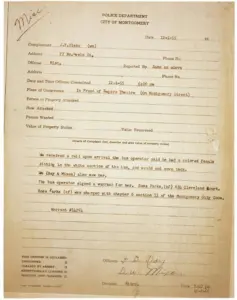
When Blake asked if she intended to stand, Parks refused. Blake threatened her with arrest, to which Parks responded: “You may do that.” She considered physically resisting, but decided against it, as she “didn’t have any way of fighting back”. Blake then left the bus and called his supervisor from a nearby payphone. His supervisor advised him to call the police. Two officers arrived on the scene, and, at the insistence of Blake, arrested Parks for violating the Montgomery municipal code.
According to biographer Douglas G. Brinkley, Parks’s refusal to move was not premeditated. Parks’s former classmate, Mary Fair Burks, also clarified that Parks was not acting on behalf of the NAACP, as she “would have done so openly and demanded a group action on the part of the organization”. Parks said of her refusal to move:
People always say that I didn’t give up my seat because I was tired, but that isn’t true. I was not tired physically, or no more tired than I usually was at the end of a working day. I was not old, although some people have an image of me as being old then. I was forty-two. No, the only tired I was, was tired of giving in.
Gene Herrick for the Associated Press; restored by Adam Cuerden, Public domain, via Wikimedia Commons

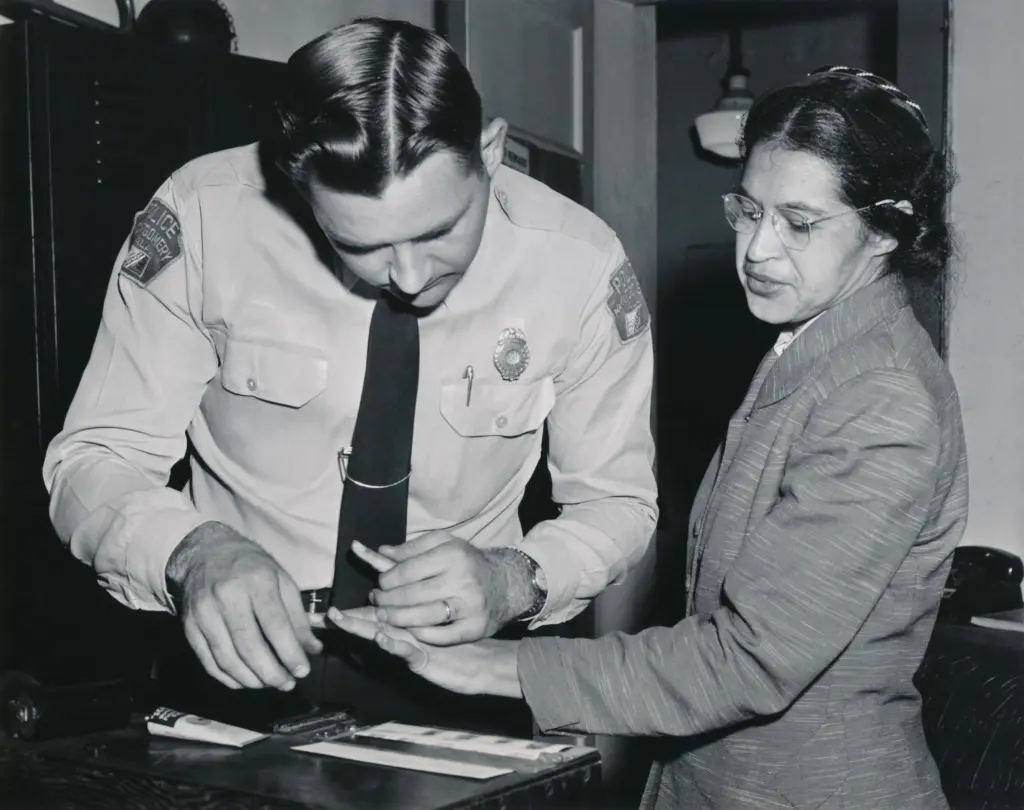
After her arrest, Parks was taken to Montgomery city hall, where she filled out her arrest forms. She was then taken to the city jail, where she was fingerprinted and photographed. After repeated requests, she was granted permission to call home, notifying her mother of her arrest and asking for Raymond to come. E. D. Nixon was also informed of Parks’s arrest and drove to the jail with Clifford and Virginia Durr, where he paid Parks’s bail.