




Michael King Jr. was born on January 15, 1929, in Atlanta, the second of three children of Michael King and Alberta King (née Williams). Alberta’s father, Adam Daniel Williams, was a minister in rural Georgia, moved to Atlanta in 1893, and became pastor of the Ebenezer Baptist Church in the following year. Williams married Jennie Celeste Parks. Michael Sr. was born to sharecroppers James Albert and Delia King of Stockbridge, Georgia; he was likely of Mende (Sierra Leone) descent. He enrolled in Morehouse College to study for entry to the ministry. Michael Sr. and Alberta began dating in 1920, and married on November 25, 1926. Until Jennie’s death in 1941, their home was on the second floor of Alberta’s parents’ home, where King was born. Michael Jr. had an older sister, Christine King Farris, and a younger brother, Alfred Daniel King.
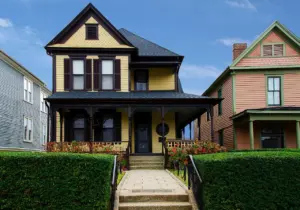
By Mikefairbanks – Own work, CC BY-SA 3.0, Link
At his childhood home, Martin Jr. and his two siblings read aloud the Bible as instructed by their father. After dinners, Martin Jr.’s grandmother Jennie, whom he affectionately referred to as “Mama”, told lively stories from the Bible. Martin Jr.’s father regularly used whippings to discipline his children, sometimes having them whip each other. Martin Sr. later remarked, “[Martin Jr.] was the most peculiar child whenever you whipped him. He’d stand there, and the tears would run down, and he’d never cry.” Once, when Martin Jr. witnessed his brother A.D. emotionally upset his sister Christine, he took a telephone and knocked A.D. unconscious with it. When Martin Jr. and his brother were playing at their home, A.D. slid from a banister and hit Jennie, causing her to fall unresponsive. Martin Jr., believing her dead, blamed himself and attempted suicide by jumping from a second-story window, but rose from the ground after hearing that she was alive.

Christianity
As a Christian minister, King’s main influence was Jesus Christ and the Christian gospels, which he would almost always quote in his speeches.[citation needed] King’s faith was strongly based in the Golden Rule, loving God above all, and loving your enemies. His nonviolent thought was also based in the injunction to turn the other cheek in the Sermon on the Mount, and Jesus’ teaching of putting the sword back into its place (Matthew 26:52). In his Letter from Birmingham Jail, King urged action consistent with what he describes as Jesus’ “extremist” love, and also quoted numerous other Christian pacifist authors. In another sermon, he stated:
Before I was a civil rights leader, I was a preacher of the Gospel. This was my first calling and it still remains my greatest commitment. You know, actually all that I do in civil rights I do because I consider it a part of my ministry. I have no other ambitions in life but to achieve excellence in the Christian ministry. I don’t plan to run for any political office. I don’t plan to do anything but remain a preacher. And what I’m doing in this struggle, along with many others, grows out of my feeling that the preacher must be concerned about the whole man.
King’s private writings as an undergraduate in seminary show that he rejected biblical literalism; he described the Bible as “mythological”, doubted that Jesus was born of a virgin and did not believe that the story of Jonah and the whale was true.
Among the thinkers who influenced King’s theological outlook were L. Harold DeWolf, Edgar Brightman, Peter Bertocci, Walter George Muelder, Walter Rauschenbusch, and Reinhold Niebuhr.
The Measure of a Man
In 1959, King published a short book called The Measure of a Man, which contained his sermons “What is Man?” and “The Dimensions of a Complete Life”. The sermons argued for man’s need for God’s love and criticized the racial injustices of Western civilization.
Nonviolence

World peace through nonviolent means is neither absurd nor unattainable. All other methods have failed. Thus we must begin anew. Nonviolence is a good starting point. Those of us who believe in this method can be voices of reason, sanity, and understanding amid the voices of violence, hatred, and emotion. We can very well set a mood of peace out of which a system of peace can be built.
—Martin Luther King Jr.
African-American civil rights activist Bayard Rustin was King’s first regular advisor on nonviolence. King was also advised by the white activists Harris Wofford and Glenn Smiley. Rustin and Smiley came from the Christian pacifist tradition, and Wofford and Rustin both studied Mahatma Gandhi’s teachings. Rustin had applied nonviolence with the Journey of Reconciliation campaign in the 1940s, and Wofford had been promoting Gandhism to Southern blacks since the early 1950s.
When receiving the Nobel Peace Prize in 1964, King hailed the “successful precedent” of using nonviolence “by Mohandas K. Gandhi to challenge the might of the British Empire … He struggled only with the weapons of truth, soul force, non-injury and courage.” Another influence was Henry David Thoreau’s essay On Civil Disobedience and its theme of refusing to cooperate with an evil system. He also was greatly influenced by the works of Protestant theologians Reinhold Niebuhr and Paul Tillich, and said that Walter Rauschenbusch’s Christianity and the Social Crisis left an “indelible imprint” on his thinking by giving him a theological grounding for his social concerns. King was moved by Rauschenbusch’s vision of Christians spreading social unrest in “perpetual but friendly conflict” with the state, simultaneously critiquing it and calling it to act as an instrument of justice. However, he was apparently unaware of the American tradition of Christian pacifism exemplified by Adin Ballou and William Lloyd Garrison. King frequently referred to Jesus’ Sermon on the Mount as central for his work. Before 1960, King also sometimes used the concept of “agape” (brotherly Christian love).
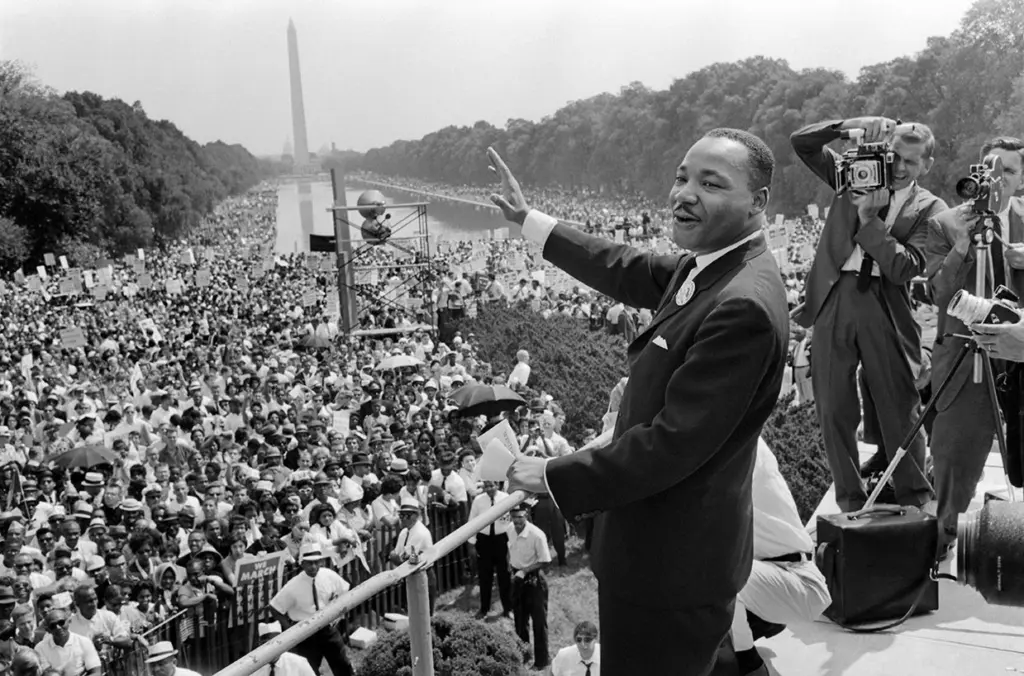

On March 29, 1968, King went to Memphis, Tennessee, in support of the black sanitation workers, who were represented by American Federation of State, County and Municipal Employees (AFSCME) Local 1733. The workers had been on strike since March 12 for higher wages and better treatment. In one incident, black street repairmen received pay for two hours when they were sent home because of bad weather, but white employees were paid for the full day.
On April 3, King addressed a rally and delivered his “I’ve Been to the Mountaintop” address at Mason Temple. King’s flight to Memphis had been delayed by a bomb threat against his plane. In reference to the bomb threat, King said:
And then I got to Memphis. And some began to say the threats, or talk about the threats that were out. What would happen to me from some of our sick white brothers? Well, I don’t know what will happen now. We’ve got some difficult days ahead. But it doesn’t matter with me now. Because I’ve been to the mountaintop. And I don’t mind. Like anybody, I would like to live a long life. Longevity has its place. But I’m not concerned about that now. I just want to do God’s will. And He’s allowed me to go up to the mountain. And I’ve looked over. And I’ve seen the promised land. I may not get there with you. But I want you to know tonight, that we, as a people, will get to the promised land. So I’m happy, tonight. I’m not worried about anything. I’m not fearing any man. Mine eyes have seen the glory of the coming of the Lord.
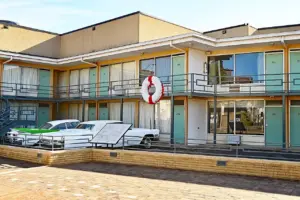
By Bubba73 – Own work, CC BY-SA 3.0, Link
King was booked in Room 306 at the Lorraine Motel in Memphis. Ralph Abernathy, who was present at the assassination, testified to the United States House Select Committee on Assassinations that King and his entourage stayed at Room 306 so often that it was known as the “King-Abernathy suite”. According to Jesse Jackson, who was present, King’s last words were spoken to musician Ben Branch, who was scheduled to perform that night at an event King was attending: “Ben, make sure you play ‘Take My Hand, Precious Lord’ in the meeting tonight. Play it real pretty.”
King was fatally shot by James Earl Ray at 6:01 p.m., Thursday, April 4, 1968, as he stood on the motel’s second-floor balcony. The bullet entered through his right cheek, smashing his jaw, then traveled down his spinal cord before lodging in his shoulder. Abernathy heard the shot from inside the motel room and ran to the balcony to find King on the floor.
After emergency surgery, King died at St. Joseph’s Hospital at 7:05 p.m. According to biographer Taylor Branch, King’s autopsy revealed that though only 39 years old, he “had the heart of a 60 year old”, which Branch attributed to stress. King was initially interred in South View Cemetery in South Atlanta, but in 1977, his remains were transferred to a tomb on the site of the Martin Luther King Jr. National Historical Park.
The assassination led to race riots in Washington, D.C., Chicago, Baltimore, Louisville, Kansas City, and dozens of other cities. Presidential candidate Robert F. Kennedy was on his way to Indianapolis for a campaign rally when he was informed of King’s death. He gave a short, improvised speech to the gathering of supporters informing them of the tragedy and urging them to continue King’s ideal of nonviolence. The following day, he delivered a prepared response in Cleveland. James Farmer Jr. and other civil rights leaders also called for non-violent action, while the more militant Stokely Carmichael called for a more forceful response. The city of Memphis quickly settled the strike on terms favorable to the sanitation workers.
The plan to set up a shantytown in Washington, D.C., was carried out soon after the April 4 assassination. Criticism of King’s plan was subdued in the wake of his death, and the SCLC received an unprecedented wave of donations to carry it out. The campaign officially began in Memphis, on May 2, at the hotel where King was murdered. Thousands of demonstrators arrived on the National Mall and stayed for six weeks, establishing a camp they called “Resurrection City”.
President Johnson tried to quell the riots by making telephone calls to civil rights leaders, mayors and governors and told politicians that they should warn the police against the unwarranted use of force. “I’m not getting through,” Johnson told his aides. “They’re all holing up like generals in a dugout getting ready to watch a war.” Johnson declared April 7 a national day of mourning for King. Vice President Hubert Humphrey attended King’s funeral on behalf of the President, as there were fears that Johnson’s presence might incite protests and perhaps violence. At his widow’s request, King’s last sermon at Ebenezer Baptist Church, given on February 4, 1968, was played at the funeral,
I’d like somebody to mention that day that Martin Luther King Jr. tried to give his life serving others. I’d like for somebody to say that day that Martin Luther King Jr. tried to love somebody. I want you to say that day that I tried to be right on the war question. I want you to be able to say that day that I did try to feed the hungry. I want you to be able to say that day that I did try in my life to clothe those who were naked. I want you to say on that day that I did try in my life to visit those who were in prison. And I want you to say that I tried to love and serve humanity. Yes, if you want to say that I was a drum major. Say that I was a drum major for justice. Say that I was a drum major for peace. I was a drum major for righteousness. And all of the other shallow things will not matter. I won’t have any money to leave behind. I won’t have the fine and luxurious things of life to leave behind. But I just want to leave a committed life behind.

Simon J. Kurtz, Public domain, via Wikimedia Commons

His friend Mahalia Jackson sang his favorite hymn, “Take My Hand, Precious Lord”, at the funeral. The assassination helped to spur the enactment of the Civil Rights Act of 1968. Two months after King’s death, James Earl Ray—on the loose from a previous prison escape—was captured at London Heathrow Airport while trying to reach white-ruled Rhodesia on a false Canadian passport. He was using the alias Ramon George Sneyd. Ray was quickly extradited to Tennessee and charged with King’s murder. He confessed on March 10, 1969, though he recanted this confession three days later. On the advice of his attorney Percy Foreman, Ray pleaded guilty to avoid the possibility of the death penalty. He was sentenced to a 99-year prison term. Ray later claimed a man he met in Montreal, Quebec, with the alias “Raoul” was involved and that the assassination was the result of a conspiracy. He spent the remainder of his life attempting, unsuccessfully, to withdraw his guilty plea and secure the trial he never had. Ray died in 1998 at age 70.
Mary’s Cafe Sit-In, 1950
On Sunday, June 11, 1950, King, classmate at Crozer Seminary and housemate Walter McCall, and their dates Doris Wilson and Pearl Smith attended church services in Merchantville. Afterwards they stopped at tavern Mary’s Cafe in Maple Shade for beers. The foursome were left waiting without anyone approaching them for service, not unexpectedly. A friend’s father and King and McCall’s landlord Jesthroe Hunt had warned them Black people were not welcome at Mary’s. King replied to the effect of maybe they needed to go, so they could start to go anywhere they wanted. The seminarians had opted for Mary’s Cafe with full knowledge of its reputation. After waiting without service, McCall approached the bar.
McCall asked bartender and Mary’s Cafe owner Ernest Nichols for packaged goods (beer for takeaway). Nichols refused, explaining he could not sell packaged goods on Sundays or any day after 10pm, by law. McCall then requested 4 glasses of beer to which Nichols answered “no beer, Mr! Today is Sunday”. Nichols would claim they sought him to violate New Jersey’s blue law (a restriction common in South Jersey and Pennsylvania as a remnant of the influence of their Quakers roots). McCall requested ginger ales as non-alcoholic beverages were not subject to the blue law. Nichols refused the group even ginger ales and reportedly stated “the best thing would be for you to leave”. King and company met refusal with refusal, and remained in their seats as was their right per New Jersey’s 1945 anti-discrimination law, which guaranteed non-discrimination by race in public accommodations. Nichols stomped out and returned with a gun standing outside firing into the air reportedly shouting “I’d kill for less”. Fearing for their lives, the four activists ran from the tavern. The group went to the Maple Shade Police Department where officers refused to file their complaint. King and McCall contacted Ulysses Simpson Wiggins then President of the Camden County Branch NAACP, who helped them successfully file a police report. The New York Times confirms “The complaint was against Ernest Nichols, a white tavern owner in Maple Shade, N.J., and said that he had refused to serve the black students and their dates in June 1950, and had threatened them by firing a gun in the air. The complaint was signed by the two students. One of the signatures, in a loopy, slanted cursive, reads ‘M. L. King Jr.'”
Nichols was charged with disorderly conduct and violation of the anti-discrimination law. He was found guilty and fined $50, however the racial discrimination count was dismissed. In a statement submitted “in the spirit of assisting the Prosecutor” Nichol’s attorney noted:
Mr. Nichols claims that this act was not intended as a threat to his colored patrons. The colored patrons, on the other hand, while they admit that the gun was not pointed at them or any of them, seemed to think that it was a threat. Mr. Nichols on the other hand states that he has been held up before and he wanted to alert his watchdog who was somewhere outside on the tavern grounds.
— Statement on Behalf of Ernest Nichols, State of New Jersey vs. Ernest Nichols, by W. Thomas McGann
King cited the incident saying it was “a formative step” in his “commitment to a more just society.” The Mary’s Cafe sit-in demonstrated the power of non-violent civil disobedience. Nichols’ reaction in retrieving a weapon and discharging it to scare the group, or summon his guard dog, to young people’s refusal to leave unserved, showed King the potency of such tactics. This sit-in is believed to be the first deployment of the non-violence and civil disobedience tactics which would distinguish King’s activism and legacy.
The Mary’s Cafe sit-in occurred six months prior to Mordecai Johnson’s Lecture on Gandi at the First Unitarian Church of Philadelphia on November 19, 1950 where King would be formally exposed to these tactics. At that lecture and in discussions with Dr. Johnson at the Fellowship House, Dr. King would be inspired and galvanized by how Mahatma Gandhi integrated Henry David Thoreau’s theory of Nonviolent resistance and civil disobedience tactics. Patrick Duff, a South Jersey resident, discovered the police report detailing the events at Mary’s after searching the archive at The Martin Luther King, Jr. Research and Education Institute.
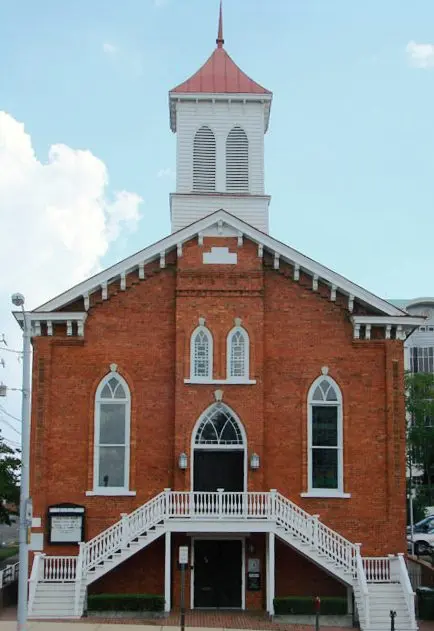
The Dexter Avenue Baptist Church was influential in the Montgomery African-American community. As the church’s pastor, King became known for his oratorical preaching in Montgomery and surrounding region.
In March 1955, Claudette Colvin—a black schoolgirl in Montgomery—refused to give up her bus seat to a white man in violation of Jim Crow laws, local laws in the Southern US that enforced racial segregation.
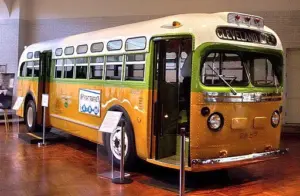
Rmhermen, CC BY-SA 3.0, via Wikimedia Commons

On December 1, 1955, Rosa Parks was arrested for refusing to give up her seat on a city bus. These incidents led to the Montgomery bus boycott, which was urged and planned by Edgar Nixon and led by King. The other ministers asked him to take a leadership role because his relative newness to community leadership made it easier for him to speak out. King was hesitant but decided to do so if no one else wanted it.
The boycott lasted for 385 days, and the situation became so tense that King’s house was bombed. King was arrested for traveling 30 mph in a 25 mph zone and jailed, which drew the attention of national media, and increased King’s public stature. The controversy ended when the US District Court issued a ruling in Browder v. Gayle that prohibited racial segregation on Montgomery public buses.
King first rose to prominence in the civil rights movement while minister of Dexter Avenue Baptist Church in Montgomery, Alabama. King’s role in the bus boycott transformed him into a national figure and the best-known spokesman of the civil rights movement.
Southern Christian Leadership Conference
Altairisfar, Public domain, via Wikimedia Commons

In 1957, King, Ralph Abernathy, Fred Shuttlesworth, Joseph Lowery, and other activists founded the Southern Christian Leadership Conference (SCLC). The group was created to harness the moral authority and organizing power of black churches to conduct nonviolent protests in the service of civil rights reform. The group was inspired by the crusades of evangelist Billy Graham, who befriended King, as well as the national organizing of the group In Friendship, founded by King allies Stanley Levison and Ella Baker. King led the SCLC until his death. The SCLC’s 1957 Prayer Pilgrimage for Freedom was the first time King addressed a national audience.
Harry Wachtel joined King’s legal advisor Clarence B. Jones in defending four ministers of the SCLC in the libel case Abernathy et al. v. Sullivan; the case was litigated about the newspaper advertisement “Heed Their Rising Voices”. Wachtel founded a tax-exempt fund to cover the suit’s expenses and assist the civil rights movement through more effective fundraising. King served as honorary president of this organization, named the “Gandhi Society for Human Rights”. In 1962, King and the Gandhi Society produced a document that called on President Kennedy to issue an executive order to deliver a blow for civil rights as a kind of Second Emancipation Proclamation. Kennedy did not execute the order. The FBI, under written directive from Attorney General Robert F. Kennedy, began tapping King’s telephone line in the fall of 1963. Kennedy was concerned that public allegations of communists in the SCLC would derail the administration’s civil rights initiatives. He warned King to discontinue these associations and felt compelled to issue the directive that authorized the FBI to wiretap King and other SCLC leaders. FBI Director J. Edgar Hoover feared the civil rights movement and investigated the allegations of communist infiltration. When no evidence emerged to support this, the FBI used the incidental details caught on tape over the next five years, as part of its COINTELPRO program, in attempts to force King out of his leadership position.
King believed that organized, nonviolent protest against the system of southern segregation known as Jim Crow laws would lead to extensive media coverage of the struggle for black equality. Journalistic accounts and televised footage of the daily indignities suffered by southern blacks, and of segregationist violence and harassment, produced a wave of sympathetic public opinion that convinced most Americans that the civil rights movement was the most important political issue in the early 1960s.
King organized and led marches for blacks’ right to vote, desegregation, labor rights, and other basic civil rights. Most of these rights were successfully enacted into law with the Civil Rights Act of 1964 and the 1965 Voting Rights Act. The SCLC used tactics of nonviolent protest with success, by strategically choosing the methods and places in which protests were carried out. There were often dramatic stand-offs with segregationist authorities, who sometimes turned violent.
Survived knife attack, 1958
On September 20, 1958, King was signing copies of his book Stride Toward Freedom in Blumstein’s department store in Harlem when Izola Curry—a mentally ill black woman who thought King was conspiring against her with communists—stabbed him in the chest with a letter opener, which nearly impinged on the aorta. King received first aid by police officers Al Howard and Philip Romano. King underwent surgery by Aubre de Lambert Maynard, Emil Naclerio and John W. V. Cordice; he remained hospitalized for weeks. Curry was later found mentally incompetent to stand trial.
Atlanta sit-ins, prison sentence, and the 1960 elections
King led the Southern Christian Leadership Conference and later became co-pastor with his father at Ebenezer Baptist Church in Atlanta (pulpit and sanctuary pictured).
In December 1959, after being based in Montgomery for five years, King announced his return to Atlanta at the request of the SCLC. In Atlanta, King served until his death as co-pastor with his father at the Ebenezer Baptist Church. Georgia governor Ernest Vandiver expressed open hostility towards King’s return. He claimed that “wherever M. L. King Jr., has been there has followed in his wake a wave of crimes”, and vowed to keep King under surveillance. On May 4, 1960, King drove writer Lillian Smith to Emory University when police stopped them. King was cited for “driving without a license” because he had not yet been issued a Georgia license. King’s Alabama license was still valid, and Georgia law did not mandate any time limit for issuing a local license. King paid a fine but was unaware his lawyer agreed to a plea deal that included probation.
Meanwhile, the Atlanta Student Movement had been acting to desegregate businesses and public spaces, organizing the Atlanta sit-ins from March 1960 onwards. In August the movement asked King to participate in a mass October sit-in, timed to highlight how 1960’s Presidential election campaigns had ignored civil rights. The coordinated day of action took place on October 19. King participated in a sit-in at the restaurant inside Rich’s, Atlanta’s largest department store, and was among the many arrested. The authorities released everyone over the next few days, except King. Invoking his probationary plea deal, Judge J. Oscar Mitchell sentenced King on October 25 to four months of hard labor. Before dawn the next day, King was transported to Georgia State Prison.
The arrest and harsh sentence drew nationwide attention. Many feared for King’s safety, as he started a sentence with people convicted of violent crimes, many white and hostile to his activism. Presidential candidates were asked to weigh in, at a time when parties were courting the support of Southern Whites and their political leadership including Governor Vandiver. Nixon, with whom King had a closer relationship before, declined to make a statement despite a visit from Jackie Robinson requesting his intervention. Nixon’s opponent John F. Kennedy called the governor, enlisted his brother Robert to exert more pressure on state authorities, and, at the request of Sargent Shriver, called King’s wife to offer his help. The pressure from Kennedy and others proved effective, and King was released two days later. King’s father decided to openly endorse Kennedy’s candidacy for the November 8 election which he narrowly won.
After the October 19 sit-ins and following unrest, a 30-day truce was declared in Atlanta for desegregation negotiations. However, negotiations failed and sit-ins and boycotts resumed for several months. On March 7, 1961, a group of Black elders including King notified student leaders that a deal had been reached: the city’s lunch counters would desegregate in fall 1961, in conjunction with the court-mandated desegregation of schools. Many students were disappointed at the compromise. In a meeting on March 10 at Warren Memorial Methodist Church, the audience was hostile and frustrated. King gave an impassioned speech calling participants to resist the “cancerous disease of disunity”, helping to calm tensions.