





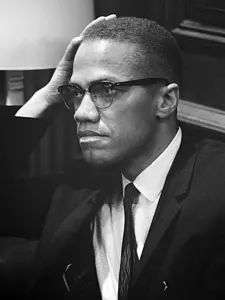
Marion S. Trikosko, Public domain, via Wikimedia Commons

Malcolm X has been described as one of the most influential African Americans in history. He is credited with raising the self-esteem of Black Americans and reconnecting them with their African heritage. He is largely responsible for the spread of Islam in the Black community in the United States. Many African Americans, especially those who lived in cities in the Northern and Western United States, felt that Malcolm X articulated their complaints concerning inequality better than did the mainstream civil rights movement. One biographer says that by giving expression to their frustration, Malcolm X “made clear the price that white America would have to pay if it did not accede to Black America’s legitimate demands.”
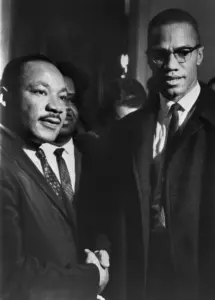
United Press International, Public domain, via Wikimedia Commons

In the late 1960s, increasingly radical Black activists based their movements largely on Malcolm X and his teachings. The Black Power movement, the Black Arts Movement, and the widespread adoption of the slogan “Black is beautiful” can all trace their roots to Malcolm X. In 1963, Malcolm X began a collaboration with Alex Haley on his life story, The Autobiography of Malcolm X. He told Haley, “If I’m alive when this book comes out, it will be a miracle.” Haley completed and published it some months after the assassination.
Malcolm X became a political symbol of Turkish Islamism, adherents of which view him as an important internal critic of the United States and the West, proof of Islam’s transformative power, and as a martyr.

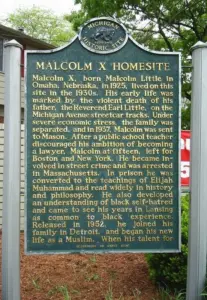
The house that once stood at 3448 Pinkney Street in North Omaha, Nebraska, was the first home of Malcolm Little with his birth family. The house was torn down in 1965 by new owners who did not know of its connection with Malcolm X. The site was listed on the National Register of Historic Places in 1984. A Nebraska Historical Marker now marks the site. The Malcolm X—Ella Little-Collins House in the Roxbury section of Boston, Massachusetts, where Malcolm X lived with his half-sister Ella Little-Collins and began getting involved in the Nation of Islam, was added to the National Register of Historic Places in 2021. Several archaeological surveys have been performed on the house’s grounds, and there are ongoing efforts to preserve the site.
In 1968, twelve black students who occupied North Hall at University of California, Santa Barbara temporarily renamed it Malcolm X Hall to force the administration to acknowledge the needs of black students. As a result, UCSB created the Department of Black Studies.
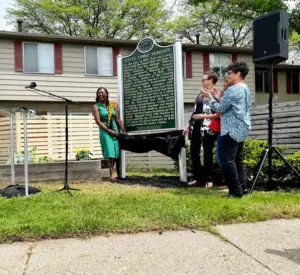
Lansing Pulse
In Lansing, Michigan, a Michigan Historical Marker was erected in 1975 on Malcolm Little’s childhood home. A new and updated marker was erected there in 2022. The city is also home to El-Hajj Malik El-Shabazz Academy, a public charter school with an Afrocentric focus. The school is located in the building where Little attended elementary school.
In cities across the United States, Malcolm X’s birthday (May 19) is commemorated as Malcolm X Day. The first known celebration of Malcolm X Day took place in Washington, D.C., in 1971. The city of Berkeley, California, has recognized Malcolm X’s birthday as a citywide holiday since 1979.
Many cities have renamed streets after Malcolm X. In 1987, New York mayor Ed Koch proclaimed Lenox Avenue in Harlem to be Malcolm X Boulevard. The name of Reid Avenue in Brooklyn, New York, was changed to Malcolm X Boulevard in 1985. Brooklyn also has El Shabazz Playground that was named after him. New Dudley Street, in the Roxbury neighborhood of Boston, was renamed Malcolm X Boulevard in the 1990s. In 1997, Oakland Avenue in Dallas, Texas, was renamed Malcolm X Boulevard. Main Street in Lansing, Michigan, was renamed Malcolm X Street in 2010. In 2016, Ankara, Turkey, renamed the street on which the U.S. is building its new embassy after Malcolm X.
Dozens of schools have been named after Malcolm X, including Malcolm X Shabazz High School in Newark, New Jersey, Malcolm Shabazz City High School in Madison, Wisconsin, Malcolm X College in Chicago, Illinois, and El-Hajj Malik El-Shabazz Academy in Lansing, Michigan. Malcolm X Liberation University, based on the Pan-Africanist ideas of Malcolm X, was founded in 1969 in North Carolina.
In 1996, the first library named after Malcolm X was opened, the Malcolm X Branch Library and Performing Arts Center of the San Diego Public Library system.
The U.S. Postal Service issued a Malcolm X postage stamp in 1999. In 2005, Columbia University announced the opening of the Malcolm X and Dr. Betty Shabazz Memorial and Educational Center. The memorial is located in the Audubon Ballroom, where Malcolm X was assassinated. Collections of Malcolm X’s papers are held by the Schomburg Center for Research in Black Culture and the Robert W. Woodruff Library.
After a community-led initiative, Conrad Grebel University College in Canada (affiliated with the University of Waterloo) launched the Malcolm X Peace and Conflict Studies Scholarship in 2021 to support black and Indigenous students enrolled in their Master of Peace and Conflict Studies program.
In 2024, Malcolm X was inducted into the Nebraska Hall of Fame, with a bust of him being placed in the Nebraska State Capitol.