




Ruby Bridges, Civil Rights Activist

Ruby Nell Bridges Hall (born September 8, 1954) is an American civil rights activist. She was the first African American child to attend formerly whites-only William Frantz Elementary School in Louisiana during the New Orleans school desegregation crisis on November 14, 1960. She is the subject of a 1964 painting, The Problem We All Live With, by Norman Rockwell.

This Black History Month story is brought to you by

The early years

Bridges was the eldest of five children born to Abon and Lucille Bridges. As a child, she spent much time taking care of her younger siblings, though she also enjoyed playing jump rope and softball and climbing trees. When she was four years old, the family relocated from Tylertown, Mississippi, where Bridges was born, to New Orleans, Louisiana. In 1960, when she was six years old, her parents responded to a request from the National Association for the Advancement of Colored People (NAACP) and volunteered her to participate in the integration of the New Orleans school system, even though her father was hesitant.

a-wchb-black-history-month-story
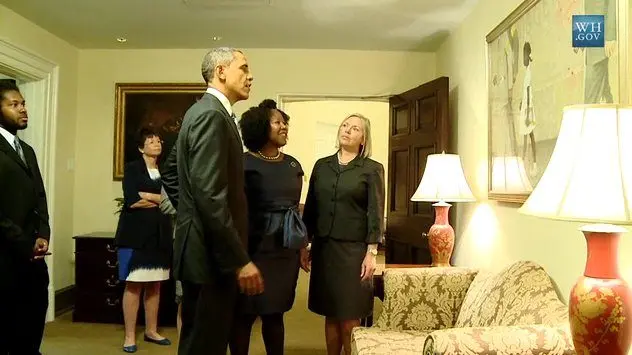
Ruby Bridges visits President Barack Obama at the White House
By Executive Office staff - Extracted from the video posted on whitehouse.gov, http://www.whitehouse.gov/photos-and-video/video/2011/07/15/ruby-bridges-visits-president-and-her-portrait, Public Domain, Link
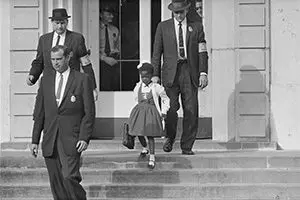
Ruby Ridges on school steps
By Uncredited DOJ photographer, restored by Adam Cuerden (a relatively minor restoration) – Via [1], Public Domain, Link

Bridges attended a segregated kindergarten in 1959. In early 1960, Bridges was one of six black children in New Orleans to pass the test that determined whether they could go to the all-white William Frantz Elementary School. Two of the six decided to stay at their old school, Bridges went to Frantz by herself, and three children (Gail Etienne, Leona Tate and Tessie Prevost) were transferred to the all-white McDonogh No. 19 Elementary School. All four 6-year-old girls were escorted to school by federal marshals during the first day they attended the two schools. In the following days of that year, federal marshals continued to escort them.

Bridges’s father was initially reluctant, but her mother felt strongly that the move was needed not only to give her own daughter a better education, but to “take this step forward … for all African-American children”. Her mother finally convinced her father to let her go to the school.

Judge J. Skelly Wright’s court order for the first day of integrated schools in New Orleans on Monday, November 14, 1960, was commemorated by Norman Rockwell in the painting, The Problem We All Live With (published in Look magazine on January 14, 1964). As Bridges describes it, “Driving up I could see the crowd, but living in New Orleans, I actually thought it was Mardi Gras. There was a large crowd of people outside of the school. They were throwing things and shouting, and that sort of goes on in New Orleans at Mardi Gras.” Former United States Deputy Marshal Charles Burks later recalled, “She showed a lot of courage. She never cried. She didn’t whimper. She just marched along like a little soldier, and we’re all very, very proud of her.”

Protests slowly give way to acceptance

As soon as Bridges entered the school, white parents pulled their own children out; all the teachers except for one refused to teach while a black child was enrolled. Only one person agreed to teach Bridges, and that was Barbara Henry, from Boston, Massachusetts, and for over a year Henry taught her alone, “as if she were teaching a whole class.”

That first day, Bridges and her mother spent the entire day in the principal’s office; the chaos of the school prevented their moving to the classroom until the second day. On the second day, however, a white student broke the boycott and entered the school when a 34-year-old Methodist minister, Lloyd Anderson Foreman, walked his five-year-old daughter Pam through the angry mob, saying, “I simply want the privilege of taking my child to school”. A few days later, other white parents began bringing their children, and the protests began to subside.

All content Wikipedia contributors, except where otherwise noted. (2025, November 27). Ruby Bridges. In Wikipedia, The Free Encyclopedia. Retrieved 19:54, January 27, 2026, from https://en.wikipedia.org/w/index.php?title=Ruby_Bridges&oldid=1324332486

Loading...